AI for Good: Accelerating Economic Digital Inclusion Across Sectors in Africa
“Africa’s AI future must belong to everyone.”-Director for Strategy and Partnerships, Fetsi Impact Hub
What emerged from the AI for Good: Accelerating Economic Digital Inclusion Across Sectors in Africa dialogue at Science Forum South Africa (SFSA) 2025 was not simply a policy conversation — it was a defining moment in Africa’s digital transition.
As delegates from across government, industry, academia, entrepreneurship ecosystems and civil society convened under one roof, the message was unmistakable: artificial intelligence will shape Africa’s economic future. The real question is whether that future will be inclusive by design or unequal by default.
The side event, hosted as part of SFSA 2025, created a rare convergence of policymakers, technologists, SME leaders, financial regulators and digital infrastructure specialists to interrogate one urgent challenge — how to accelerate AI adoption in ways that expand economic opportunity rather than concentrate it.
Across discussions, participants acknowledged that AI adoption across the continent remains uneven. While innovation hubs and major cities are advancing rapidly, vast segments of the population — particularly women, youth in rural areas, persons with disabilities, and small enterprises — remain at risk of exclusion. Without deliberate governance, intentional infrastructure investment, and structured capacity development, AI could deepen existing inequalities.
Yet the tone of the forum was not cautionary alone — it was catalytic.
Africa, participants agreed, has a unique opportunity to build AI ecosystems that are human-centred, secure, resilient and grounded in local realities. Rather than importing fragmented frameworks, there is growing momentum to shape governance models that reflect African contexts, values and economic priorities.
A strong theme throughout the dialogue was the centrality of small and medium-sized enterprises. SMEs are the backbone of employment and economic activity across Africa, yet many lack the digital readiness, cybersecurity safeguards and financial access required to participate meaningfully in the AI economy. Delegates underscored that enabling SMEs with tools, training, and secure digital infrastructure is not a peripheral issue — it is an economic imperative.
Security and trust surfaced as equally critical pillars. Experts highlighted that AI systems are only as strong as the infrastructure on which they run. Strengthening ransomware resilience, embedding Zero Trust principles across public systems, and safeguarding financial technologies were identified as foundational steps toward equitable digital transformation. In a continent where digital public services are expanding rapidly, governance gaps present real risks to citizens if oversight mechanisms are not strengthened in parallel.
Public-sector readiness was another focal point. Many municipalities and national departments are exploring AI deployment in healthcare, education, transport and financial administration, yet lack comprehensive ethical frameworks, procurement guidelines and citizen data protection structures. The forum reinforced the urgency of building institutional capacity to govern AI responsibly while still enabling innovation.
Financial integrity also featured prominently. As AI increasingly influences digital payments, fraud detection and financial systems, regulators must evolve frameworks to protect consumers, secure transactions and prevent systemic vulnerabilities. Ensuring that AI strengthens — rather than destabilises — financial inclusion efforts is central to sustainable growth.
What distinguished this dialogue was not merely the identification of challenges, but the articulation of a practical roadmap. Participants converged on the need for coordinated national and city-level AI governance frameworks, targeted SME readiness programmes, inclusive design standards, strengthened digital infrastructure and regional policy harmonisation. Youth-focused training pathways, accessible AI education for persons with disabilities, and multidisciplinary research ecosystems were positioned as long-term investments in continental competitiveness.
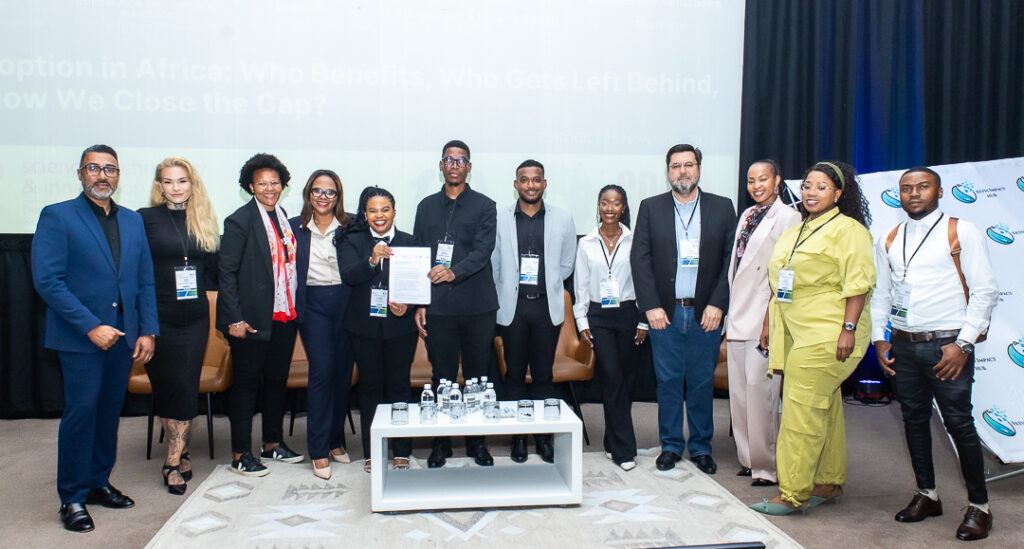
The communiqué emerging from the session reflects a collective commitment: Africa’s AI transformation must be resilient, fair, secure and people-centred. It must protect communities while unlocking productivity. It must enable entrepreneurs while safeguarding citizens. And it must prioritise inclusion as a structural principle, not an afterthought.
For millions of young entrepreneurs across the continent — and the hundreds of millions of young Africans who will inherit this digital economy — the stakes are profound. AI represents more than technological evolution; it represents a redefinition of economic participation.
Africa’s innovators are ready. Across sectors, they are building solutions that address local challenges, modernise industries and expand access to opportunity. What is required now is aligned leadership — policy environments that encourage responsible AI deployment, infrastructure investments that extend connectivity securely, and cross-sector partnerships that bridge gaps between innovation and implementation.
The discussions at SFSA 2025 made one thing clear: AI for Good cannot remain a slogan. It must become a structured agenda, embedded in governance frameworks, economic strategy, and institutional reform.
Africa’s AI future will not be determined by technology alone. It will be determined by the intentional choices made today — choices about inclusion, security, equity and shared prosperity.
And if those choices are made wisely, artificial intelligence will not divide the continent. It will accelerate its transformation.