
FETSI Impact Hub Advances Policy Framework for Inclusive AI at Science Forum South Africa 2025
Pretoria, South Africa – 25 November 2025 – A decisive shift from dialogue to policy architecture emerged at the “AI for Good: Accelerating Economic Digital Inclusion Across Sectors in Africa” side event hosted by FETSI Impact Hub during the Science Forum South Africa.
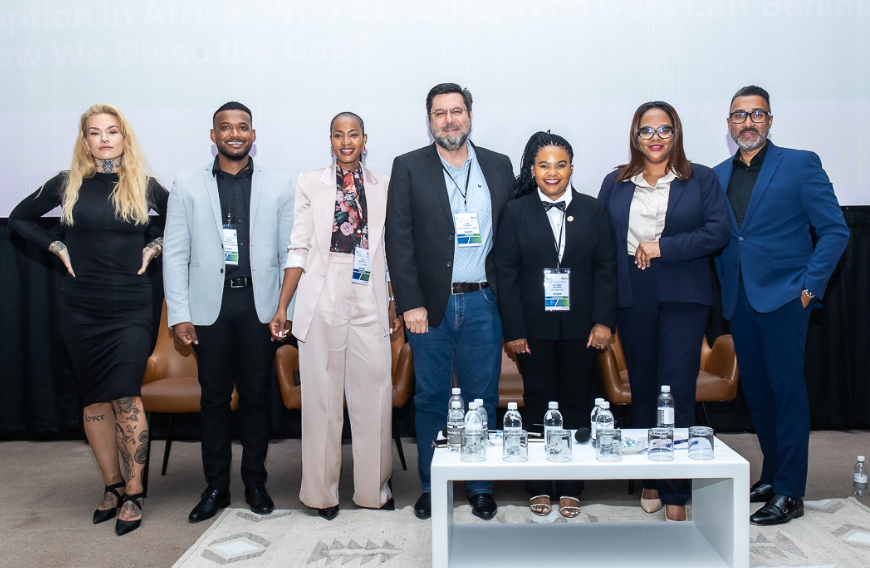
Held at the Diamond Auditorium at the CSIR International Convention Centre, the convening brought together policymakers, industry leaders, researchers, civil society actors and digital transformation practitioners to confront a defining question for the continent: how can Africa adopt artificial intelligence at scale without deepening inequality?
What distinguished this gathering was not simply the urgency of the conversation, but its deliberate orientation toward policy adoption and systems integration. Rather than framing AI as a standalone technological trend, the session positioned it as a governance priority requiring coordinated regulatory, institutional and economic reform.
Security as Public Infrastructure
Delivering the keynote address, Zaheer Haniff of Dell Technologies outlined what he described as the “resilience backbone” required for Africa’s AI future. His message was unambiguous: inclusive AI cannot exist without security architecture embedded at national and institutional levels.
He argued that Zero Trust frameworks, cyber-resilient systems and data protection standards must be treated not as private sector luxuries but as public infrastructure. In fragile digital ecosystems, weak cybersecurity disproportionately harms vulnerable communities, small enterprises and under-resourced public institutions. Trust, he noted, is not a soft principle but a structural requirement for adoption.
The policy implication was clear. African governments must integrate cyber resilience into digital transformation strategies as a foundational layer, ensuring that AI deployment across education, finance, healthcare and public administration rests on secure systems that protect citizens’ rights and data integrity.
Closing the Adoption Gap
The panel discussion moved from infrastructure to equity, interrogating who benefits from AI deployment and who remains excluded.
Danie Schoeman addressed the structural barriers facing small and medium enterprises, noting that while large corporations rapidly integrate AI tools, SMEs often lack access to capital, technical expertise and enabling infrastructure. Without targeted policy incentives, public-private partnerships and SME-focused digital readiness programmes, AI risks consolidating advantage rather than expanding opportunity.
Annika Ojala advanced the conversation into the domain of gender and fairness, cautioning that algorithmic systems can replicate or amplify existing biases if governance frameworks fail to mandate accountability. She emphasized the necessity of embedding gender-responsive design, impact audits and inclusive datasets into AI standards, ensuring that equity is codified rather than assumed.
Gerald Mariemuthoo turned attention to financial integrity and regulatory oversight, stressing that inclusive AI ecosystems require harmonised regulatory safeguards that protect consumers while enabling innovation. Fragmented policy environments, he warned, can deter responsible investment and undermine trust in digital markets.
Amelia Masubelele brought the lens squarely onto public sector governance. She underscored that ethical AI adoption within government institutions must be guided by transparent procurement standards, citizen protection mechanisms and clear accountability structures. Human-centred governance, she argued, is not merely aspirational but essential to sustaining public confidence.
Collectively, the panel’s insights converged into a central theme: inclusive AI is fundamentally a policy coordination challenge. It requires alignment across innovation policy, industrial strategy, digital regulation, education reform and public administration systems.
From Dialogue to Framework
In his insight address, Rebatho Madiba introduced what he termed the “Sixth Essential Question” to the traditional 5W1H problem-solving framework. In the context of AI governance, he argued, policymakers must go beyond asking who, what, when, where, why and how, and also ask: “Who is accountable over time?”
This intervention resonated deeply in a room conscious of rapid technological change outpacing regulatory development. Madiba’s framework offered a practical methodology for governments and institutions to evaluate AI initiatives before adoption, ensuring alignment with development priorities and social protection principles.
The closing interactive session shifted from analysis to articulation. Participants identified the core pillars of an emerging policy adoption framework for inclusive AI across Africa.
First, AI literacy must be scaled as a national competency, embedded within education systems and workforce development strategies to prevent exclusion from future labour markets. Second, regulatory harmonisation across African states must reduce fragmentation and enable cross-border digital markets aligned with continental strategies such as STISA-2034 and the African Union Digital Transformation Strategy. Third, inclusive procurement policies must incentivise SME participation and gender equity in AI innovation ecosystems. Fourth, cyber resilience and data protection must be codified as prerequisites for AI deployment in both public and private sectors.
Aligning with Continental Priorities
The dialogue reinforced alignment with continental frameworks while recognising the urgency of local implementation. Participants acknowledged that Africa’s AI future cannot be imported wholesale from external models. Instead, it must reflect local realities, developmental priorities and socio-economic contexts.
FETSI Impact Hub positioned itself as a convening and policy-bridging platform, committed to translating multi-stakeholder dialogue into structured recommendations that can inform national AI strategies, regulatory reform and public sector digital transformation roadmaps.
The event underscored a broader shift underway across the continent. AI is no longer confined to research labs or private innovation hubs. It is increasingly a matter of public governance, economic inclusion and citizen protection.
A Policy Moment for Africa
As Africa accelerates toward digital integration, the risk is not technological lag but uneven adoption. Without deliberate policy intervention, AI could widen disparities between large and small enterprises, urban and rural communities, and digitally connected and excluded populations.
FETSI Impact Hub’s convening at Science Forum South Africa 2025 marked an important inflection point. It framed inclusive AI not as a peripheral conversation but as a central policy imperative tied directly to economic participation, public trust and long-term resilience.
“AI offers Africa an unprecedented opportunity to unlock inclusive economic participation, transform public services and empower communities,” a FETSI Impact Hub representative noted during closing remarks. “But opportunity without governance can deepen inequality. Our responsibility is to ensure that AI becomes a force for inclusion, not exclusion.”
By centring security, equity, SME readiness, gender fairness and public sector accountability within a coherent adoption framework, the AI for Good session moved beyond aspiration. It began shaping the contours of a policy architecture designed to ensure that Africa’s digital transformation is inclusive, resilient and people-centred.
In Pretoria, the message was unmistakable. The age of AI in Africa will not be defined solely by technological capability. It will be defined by the strength of its governance.-Boitumelo Makgoba –Director for strategy and Partnerships at Fetsi Impact Hub

- Rated Excellent by our growing community
The Ultimate Standard for Economic Digital Inclusion
Developing Africa’s next generation of digital talent.
Your future in tech starts at Fetsi Impact Hub. Apply today and take your place in building inclusive, sustainable economic growth through technology.
Site Links
- info@fetsihub.co.za
- +2783 5129 131
- Gauteng: Oak Avenue Office Park: 376 Oak Avenue, Ferndale, Randburg 2188 South Africa
- Limpopo: 43 Blesbok Street, Founa Park, Polokwane, Limpopo, 0750
About Us
Programmes
Fetsi impact Hub Overview